The 2025 amendment to the Carbon Dioxide Act: New legal framework for CO₂ transport and storage
Update Energy No. 40
On November 6, 2025, the Federal Parliament of Germany (Bundestag) passed an amendment to the Carbon Dioxide Storage Act (Kohlendioxid-Speicherungsgesetz – KSpG). The Council of Constituent States (Bundesrat**)** approved the amendment on November 21, 2025.
The now appropriately renamed Carbon Dioxide Storage and Transport Act (KSpTG) will enable the permanent storage of carbon dioxide in underground rock strata for commercial purposes. At the same time, the act creates a uniform legal framework for the transport of carbon dioxide through pipelines for the first time.
The aim of the law is to reduce hard-to-abate industrial emissions through the use of carbon capture and storage (CCS) and carbon capture and utilization (CCU) technologies, thereby making a decisive contribution to achieving climate neutrality in Germany.
The amendment of the Act on the Prohibition of Dumping of Waste and Other Materials or Objects on the High Seas (Hohe-See-Einbringungsgesetz), necessary for the transport of CO₂ to the Exclusive Economic Zone and the amendment of Article 6 of the London Protocol enabling CO₂ export for injection abroad, remain to be approved by the Bundestag. In light of the estimated ten-year timeline for planning and developing storage projects in Germany and its Exclusive Economic Zone, the proposed legislative amendments are vital to fulfilling European climate targets.
Technical background
Carbon dioxide emissions are one of the main causes of global climate change. Comprehensive, rapid, and sustainable measures to reduce greenhouse gases are necessary to limit global warming. These include, among other things, significantly reducing carbon dioxide emissions by expanding renewable energies and increasing energy efficiency.
However, there are also emissions that cannot be completely avoided even when using technologically advanced and climate-friendly processes. Examples of this are lime or cement production, where CO₂ emissions are generated as a result of the process even when renewable energy is used. Furthermore, the necessary technology has not yet advanced sufficiently in other sectors to entirely eliminate emissions. In case of such emissions that are either unavoidable or exceedingly challenging to avoid, CCS and CCU technologies are an essential tool for minimizing the impact of CO₂ emissions on global warming, especially in cases where the emissions themselves cannot be prevented. Emissions are to be captured directly at their origin and subsequently stored or recycled.
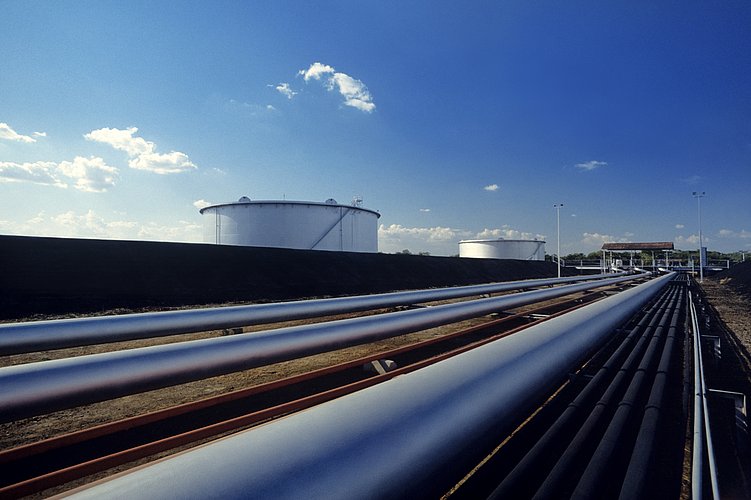
In a CCS process, the carbon dioxide produced in industrial processes is captured, transported via special pipelines to a storage site, and permanently stored in underground rock strata. Accordingly, greenhouse gases are captured and prevented from being released into the atmosphere, thereby initially averting their harmful climate impact – even if the actual emissions do not decrease.
In a CCU process, the captured carbon dioxide is reused as a raw material for industrial processes, for example in the production of fuels or construction material.
Both technologies are designed to reduce the impact of CO₂ emissions and complement traditional climate protection instruments for reducing emissions.
Climate policy background
In the Federal Climate Action Act (Bundes-Klimaschutzgesetz), Germany has committed itself to achieving greenhouse gas neutrality by 2045 at the latest. This goal can only be achieved if, in addition to the conversion of the energy supply, significant reductions are also made in energy- and resource-intensive industries. Especially, the impact of emissions that are difficult or impossible to avoid on the atmosphere must be urgently reduced.
In light of these circumstances, the German Government considers the use of CCS and CCU to be an indispensable part of a comprehensive climate strategy. The amendment to the KSpG addresses the conclusions of the evaluation report pursuant to Section 44 of the previous version of the KSpG, which highlighted the necessity for an explicit legal framework regulating large-scale CO₂ capture and storage.
EU legal background
The new regulation is closely linked to European climate policy. It implements key provisions of Regulation (EU) 2024/1735 – the so-called Net Zero Industry Act (NZIA). Under the NZIA, member states are required to accelerate the expansion of key climate-relevant technologies and ensure a minimum annual CO₂ storage capacity of at least 50 million tons within the EU by 2030. By amending the KSpG, Germany intends to make a key contribution to achieving the European climate targets.
Previous legal situation
The previous KSpG essentially only applied to research, testing, and demonstration projects.
Its scope was limited exclusively to carbon dioxide storage facilities that were applied for before January 1, 2017, and in which no more than 1.3 million tons of carbon dioxide were to be stored annually. Furthermore, annual carbon dioxide storage in Germany was strictly limited to a maximum of 4 million tons. The purpose was to evaluate the opportunities and risks relating to CO₂ storage, without enabling large-scale technical use.
Actual, large-scale storage projects were not permitted under the previous legislation. Furthermore, the law only covered carbon dioxide storage facilities; no legal framework for the systematic transport of carbon dioxide through pipelines was in place.
The amendment of the KSpG removes these previous restrictions and adapts the legal situation to the current requirements of industrial and climate policy.
Key aspects of the amendment
The aim of the reform is to enable and facilitate the permanent storage of carbon dioxide on a commercial basis. The new name – Carbon Dioxide Storage and Transport Act – reflects the expanded scope: in addition to storage, the transport of CO₂ by pipeline is now also treated as an equal subject of regulation.
Expansion of the scope of application – offshore and opt-in
The previous, highly restricted scope of application under Section 2 (1) of the KSpG (old version) has been significantly expanded. The restriction to research and demonstration projects has now been replaced by the possibility of using CCS technologies on an industrial scale.
The focus is on offshore CO₂ storage in the German continental shelf and the Exclusive Economic Zone. The objective is to ensure that permanent storage is conducted offshore, i. e. outside sensitive land areas. Storage within the 12-nautical-mile zone remains prohibited.
Storage on the mainland remains prohibited in principle, with the exception of research projects. While the previous legislation allowed the federal states the option of prohibiting storage through an "Opt-Out," the KSpTG reverses this approach: Now, the federal states can actively determine through an "Opt-In" that permanent storage of carbon dioxide is permitted on their territory or in certain regions.
This will enable the federal states to open up for CCS projects in a controlled manner, taking into account criteria such as acceptance, safety, climate protection effects, environmental impacts, transport routes, and costs for industry.
If a planned storage complex extends across the territory of several federal states, storage is only permitted in accordance with Section 2 (5) sentence 2 if all affected states have given their consent or if the state in which the injection is to take place concludes a corresponding state treaty with the other states.
Expanded definitions
Specifically, the amendment contains a long-anticipated, more precise and expanded definition of "carbon dioxide pipeline." In the future, this will include not only pipelines that transport CO₂ to a storage site, but also those that transport it for other purposes – such as to industrial facilities as part of CCU projects. The law thus takes into account technological advancements and the increasing interconnection between production, use, and storage.
Transportation – Alignment of the planning approval process with the Energy Industry Act (Energiewirtschaftsgesetz – EnWG) and determination of overriding public interest
A key aspect of the reform is the simplification of the planning approval and authorisation procedure for carbon dioxide storage projects.
The planning approval procedure for carbon dioxide pipelines will be aligned with the procedure for pipeline projects under the EnWG by modifying the general, fundamentally applicable provisions of the Administrative Procedure Act (Verwaltungsverfahrensgesetz – VwVfG) with reference to the standards of the EnWG. Due to the close alignment with the rules of the EnWG, the administration and project developers should be able to build on their experience from procedures under the EnWG.
The draft provides for several discretionary criteria for weighing up the interests affected by the project within the framework of the planning approval process.
Section 4 (1) sentence 3 expressly states that the construction, operation, and modification of carbon dioxide pipelines are in the overriding public interest. The principle of overriding public interest is not recognised in protected marine areas.
In addition, when weighing up the interests involved, particular consideration must be given to the fact that carbon dioxide pipelines serve climate protection and contribute to reducing carbon dioxide emissions in Germany.
Another discretionary specification for consideration in the context of planning approval is the general decision to assume that, in case of the bundling of carbon dioxide pipelines with existing hydrogen pipelines, there is no additional impairment of other interests. Pipelines that do not extend beyond the area of an industrial site are exempt from this obligation, Section 4 (3). In principle, projects for the construction, operation, and significant modification of carbon dioxide pipelines are to be given priority in the planning approval and planning authorisation procedures (Planfeststellungs- und Plangenehmigungsverfahren), Section 4a (5). Section 4a (2) allows existing gas, hydrogen, and product pipelines to be reclassified for the transport of carbon dioxide without the need for a new planning approval procedure.
Section 4b provides for the possibility of expropriation if the construction and operation of a pipeline serves the public interest and extends the scope of application not only to transport to storage facilities, but also to transport for use as a raw material source for carbon compounds or, in the case of CO₂ extracted from the atmosphere, to transport to storage facilities.
Carbon dioxide storage – Overriding public interest and new regulations on approval requirements
Sections 11 et seqq. regulate the construction and operation of carbon dioxide storage facilities. These are legally defined as "a spatially defined area consisting of one or more rock strata for the purpose of permanent storage, as well as the necessary underground and above-ground facilities from the point of delivery of the carbon dioxide stream to the injection facility." They require planning approval by the competent authority. The construction and operation of carbon dioxide storage facilities are also in the overriding public interest, as long as they are not located in a protected marine area, Section 11 (1) sentence 2. In view of the narrow definition of the term "carbon dioxide storage facility," the infrastructure that is usually required upstream of or between the pipelines and the storage facility does not fall within the scope of the law.
In accordance with the planning approval process, the public must be notified about the project at the latest by the time the application is submitted.
For significant changes to existing carbon dioxide storage facilities, the planning approval decision may be replaced by a plan authorisation to be granted under a simplified administrative procedure in accordance with Section 74 (6) VwVfG under the conditions set out in Section 11 (2).
Section 13 (1) sets out comprehensive material approval requirements for carbon dioxide storage facilities. The public interest must not be compromised and the project must not conflict with overriding private interests. The long-term safety of the storage facility and the protection of groundwater as source of drinking water must be guaranteed; there must be no danger to humans or the environment.
When planning the project, precautions must also be taken to prevent significant irregularities in accordance with the state of the art in science and technology in order to avoid harm to humans and the environment. So-called coverage provisions, i. e., in summary, the annually determined security for the obligations arising from operation, decommissioning, and aftercare, including liability, must be made. The operator must ensure that carbon dioxide flows comply with legal requirements.
Section 13 (2) also specifies the required content of the planning approval decision. The authorisation or approval decision may be subject to time limits, conditions, a reservation of revocation, or requirements. In order to comply with the regulations, further conditions, amendments, or additions to the conditions are possible until the "transfer of responsibility," i. e., the point in time at which the operator's aftercare obligations are transferred to the state, at the earliest 40 years after the completion of decommissioning.
Non-discriminatory access
According to Section 33 (1), operators of carbon dioxide pipeline networks and storage facilities are obliged to grant other companies access to their carbon dioxide pipeline network and storage facilities in a non-discriminatory, reasonable, and transparent manner.
No connection of coal-fired power plants
According to Section 22 (4), only the transport and storage of CO2 released by coal combustion is now prohibited.
Conclusion and outlook
While some details of the KSpTG may be criticised, it nonetheless provides a solid and pragmatic uniform legal framework for the complex CCS and CCU technologies currently in the planning phase. Given lengthy planning periods required for storage projects in Germany, it remains to be seen whether and to what extent domestic industry will choose storage capacities in Germany or instead collaborate with more advanced projects in other European countries. The development of the pipeline network and the initiatives of individual federal states towards an opt-in solution will also be decisive factors.
This article was written in collaboration with our research assistant Elsa Pauline Neumann Doolan.