Add-On Transactions in Buy-and-Build / Roll-Ups
Efficient Scaling with Standardisation and a sense of Proportion
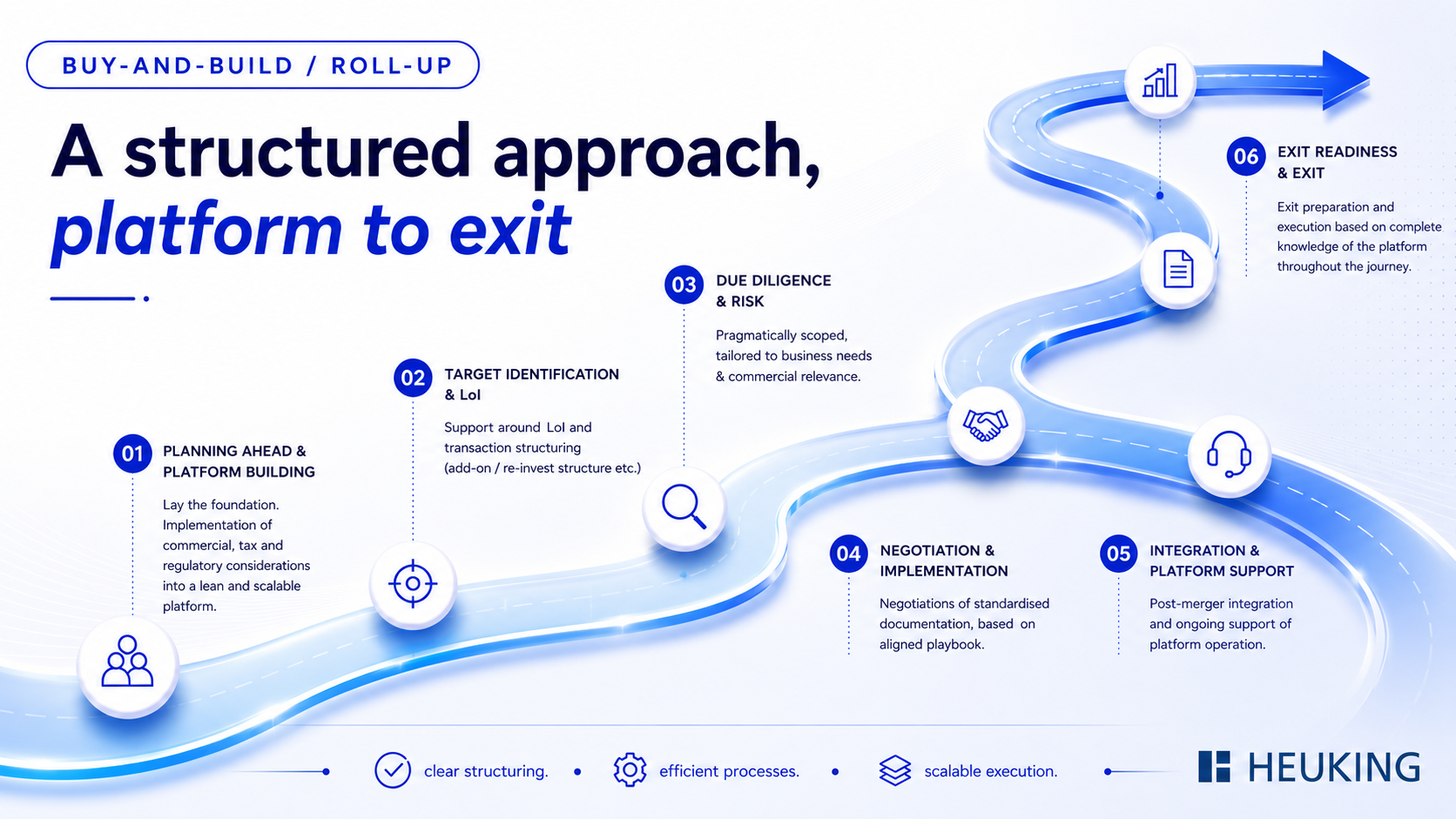
In Part 1 of this series, we examined the economic logic of buy-and-build and roll-up strategies and the central success factors from a legal perspective. Part 2 addressed the platform as the legal, economic, and organisational foundation. This third instalment turns to the operational core of the strategy: the efficient and scalable execution of the add-on transactions themselves.
1. Add-Ons as a serial process – The essential starting perspective
What fundamentally distinguishes buy-and-build and roll-up strategies from conventional one-off M&A is not the individual transaction, but the logic behind it. Add-ons are not standalone deals strung together in sequence; they are components of a serial process that must be conceived and structured as such from the outset.
This shift in perspective has far-reaching practical consequences. Decisions that can be made case by case in a one-off transaction must, in a serial model, be anticipated structurally in advance. Which documentation do we use? Which purchase price mechanics are standardisable? Where do we allow flexibility, and where do we not? How does the negotiation run – not just in the first deal, but perhaps in the seventh add-on? The real efficiency gains do not come from optimising the first transaction. They come from building a model that is just as robust at the tenth transaction as it was at the beginning.
From a legal perspective, this means every process decision should be evaluated for its repeatability. What looks like a pragmatic exception today can become a structural liability later.
2. LoI / Term sheet: A steering instrument, not a formality
One of the most consistently underestimated elements in buy-and-build processes is the letter of intent or term sheet. In conventional single transactions, it is often treated (wrongly) as a non-binding opening move: a document that captures rough parameters without committing much. In a serial model, this view is far too narrow.
In the buy-and-build context, the LoI / term sheet serves multiple functions simultaneously. It is an acquisition tool, a trust anchor for the seller, a structuring document, and the pacemaker for everything that follows. A well-crafted term sheet locks in the deal's essential parameters tightly enough that the subsequent documentation is no longer perceived as negotiating territory, but as the implementation of a framework both parties have already agreed.
In practice, it has proved effective to keep the term sheet standardised, clear, and – particularly when dealing with mid-market sellers without M&A experience – genuinely easy to understand. In terms of substance, it should go well beyond a vague price range and already map out the key economic and structural parameters: valuation and purchase price structure, cash component and any rollover equity, vendor loan, core governance assumptions, and the timeline to closing. The message this sends does not need to be stated bluntly to land: we have agreed the key parameters together – everything else follows from the group’s standard framework and process, for reasons that are straightforward to explain.
3. Transaction structure
One decision that is occasionally taken too late in practice is the choice of transaction structure.
In buy-and-build strategies, the default is a full acquisition by way of share deal. The asset deal remains an option but is reserved for clearly defined situations – where the target carries material legacy liabilities that cannot be otherwise managed structurally, or where regulatory requirements compel a different approach. What matters most is not which structure is chosen, but that the decision is made consciously, early, and consistently – and not revisited mid-process. A structural change after due diligence has begun creates additional work, confusion on the seller side, and consumes negotiating capital that would be better deployed elsewhere.
In certain sectors, such as healthcare businesses involving MVZ structures or particular regulated professional service structures, pre-structuring on the seller side may be necessary before the transaction itself can be completed: changes in legal form, carve-outs, or restructuring of existing entities. These points need to be identified early, addressed cleanly in the contracts, and – depending on who carries out the pre-structuring – priced in with appropriate implications for timeline and cost allocation.
4. Due diligence with proportionality
Due diligence in a serial model follows a different logic than in a one-off transaction. The guiding question is not: what can we review? It is: what is material enough, from an economic and liability perspective, to justify the effort for everyone involved?
A risk-conscious approach with a clearly defined scope has consistently proved far more efficient than attempting to inventory everything comprehensively. Extensive DD reports can be appropriate – for internal investment committees, third-party financing, or atypical risk profiles. In many add-on situations, however, a structured, decision-relevant summary of the key risk areas is sufficient.
An important conceptual distinction is that between due diligence as a risk assessment tool and post-merger integration as the operational follow-on step. What can be harmonised efficiently and group-wide after closing (data protection documentation, internal policies, standard contracts, IT processes) does not need to be fully resolved before signing. The DD establishes whether known or latent risks are price-relevant or give rise to liability; the PMI ensures the actual state is brought in line with the target state. Drawing this distinction consistently saves considerable effort and keeps the focus where it belongs.
A concrete efficiency gain can also be achieved by linking the data room to the warranty structure. Where aggregated lists are requested for DD purposes anyway – leases, employees, insurance policies, material customer and supplier contracts – these can serve directly as the basis for the contractual warranties, without duplicating the work.
5. Documentation as a scaling lever
The principle is straightforward: in the buy-and-build context, the buyer provides the documentation. This is not a question of leverage, but a question of efficiency, and experienced sell-side advisers will rarely be surprised by this.
This foundational decision implies a far-reaching design principle: the documentation must be modular, standardised, and built for repetition from the outset. This encompasses template SPAs and APAs, standardised articles of association and rules of procedure / governance rules, service contract templates, and clear, simple mechanics for purchase price components, liability, and rollover equity.
Two design principles have proved particularly effective. First, variables should appear at as few and as clearly defined points in the document as possible. Purchase price, parties, reference dates – these parameters are set once and referenced by definition across all downstream documents. Defining the purchase price and its calculation basis independently in three places across three schedules creates errors and unnecessary coordination overhead. Second, the documentation should be structured so that it is in principle automation-ready. At high transaction volumes, the use of structured data templates – where parties, ownership interests, and core parameters are entered once and populate all relevant documents – can yield a significant efficiency gain. This is not appropriate for every strategy, but the documentation should at least be designed so that the option remains open.
For economically and psychologically sensitive points – rollover equity, purchase price calculation, non-competes, bonuses – an additional principle applies: simplicity is king. Complex, lengthy documentation on these topics slow negotiations, create uncertainty, and generate friction that persists well beyond closing. Addressing these points clearly, comprehensibly, and in a way that can be explained in plain terms wins not only speed, but also acceptance.
6. Seller psychology as a success factor
Buy-and-build strategies frequently encounter sellers who are not seasoned M&A professionals – entrepreneurs selling the business they have built over a lifetime, often without legal counsel or with advisers who lack specific transaction experience. For this audience, a professionally assembled, scale-oriented transaction package can feel daunting at first encounter. The questions that arise are less legal than human: What am I giving up? What am I committing to? Do I actually understand what is happening here?
This reaction is normal and predictable – which means it should be anticipated in the process plan, not left to improvisation. Buyers and their advisers play an active explanatory role in this situation: structures must be explained, not merely delivered. Rollover equity concepts must be written so that they are intelligible without a legal background. Guides or FAQ documents addressing recurring questions can meaningfully reduce friction in the negotiation.
Seller psychology is not a soft side issue in this context – it is a hard efficiency factor. Sellers who feel understood and fairly treated move faster, cooperate more readily, and prove more reliable counterparties, including after closing.
7. Rollover equity: economic, timing and emotional dimensions
Rollover equity is a central but often underestimated element of the overall process. It serves not only to partially finance the purchase price and incentivise performance, but also fundamentally shapes how sellers see their role after closing. A seller who is a co-shareholder in the platform from day one thinks differently about group interests, willingness to cooperate, and exit orientation. Depending on the specific model chosen for the overall transaction, participation can be structured at different levels of the group, potentially using different instruments across multiple tiers and a range of legal constructs. Here too, the same principle applies: structural complexity should be the exception; the most efficient path is the goal.
In designing rollover equity, the tax interests of the sellers – typically their primary concern alongside purchase price structure – should be taken into account wherever possible. For sellers, this is one of the most tangible and therefore most central negotiation points.
Beyond incentivisation, rollover equity frequently determines the deal timeline in practice – and does so in an objective, readily explicable way. Capital increases at holding level typically occur only at a small number of points during the year and are based on fair market value at the relevant date. A seller who wishes to participate at an earlier, lower valuation must have the transaction completed by a certain deadline. Later entry occurs at correspondingly higher valuations. This logic is not a pressure tactic – it is a structural reality, and it imposes discipline without requiring any explicit negotiating manoeuvre.
8. Standard and exception – decided deliberately, not drifted into
Standardisation does not mean rigidity. In virtually every add-on, there will be points that require or justify a departure from the standard. That is neither unusual nor problematic – provided the departure is the result of a conscious decision, and not of a lack of process discipline or a negotiation that has taken on a life of its own.
A distinction between negotiable and non-negotiable elements (communicated clearly and early) has proved its worth in practice. As the transaction track record grows, recurring patterns of deviation can be identified and absorbed into the standard: as optional modules or defined ranges of flexibility that are handed to the deal team and advisers as a toolkit to work with autonomously. This creates genuine scalability: advisers can act faster and more independently, without waiting for case-by-case decisions.
9. Fine-tuning after the first transactions
Few transaction models offer better conditions for continuous improvement than buy-and-build. After just a handful of add-ons, clear patterns emerge: which DD topics recur consistently, where the most stubborn negotiation points arise, which clauses generate discussion that could have been avoided.
Structured fine-tuning – realistically first undertaken after the third add-on, then repeated at regular intervals – pays direct dividends in efficiency and quality. The matrix of typical negotiation points, standard positions, and pre-agreed margins of flexibility, developed jointly with advisers, is not a bureaucratic instrument. It is a practical tool that accelerates transactions and ensures consistency.
10. What follows
Individual add-on transactions are the operational backbone of every buy-and-build and roll-up strategy – and with a scalable, standardised process in place, the essential foundations for lasting success are established. This foundational series concludes here.
Deeper analysis of selected topics – competition law considerations, sector-specific particularities, add-ons by strategic acquirers, and VC-driven platforms – will follow in the coming weeks as focused articles on this page.
The team at HEUKING is always available for your questions or direct discussion.