The Platform as Foundation
Structure, Governance, and Role Design in the Buy-and-Build / Roll-Up Context
In Part 1 of this series, we examined what buy-and-build and roll-up strategies actually involve and identified the key success factors from a legal perspective.
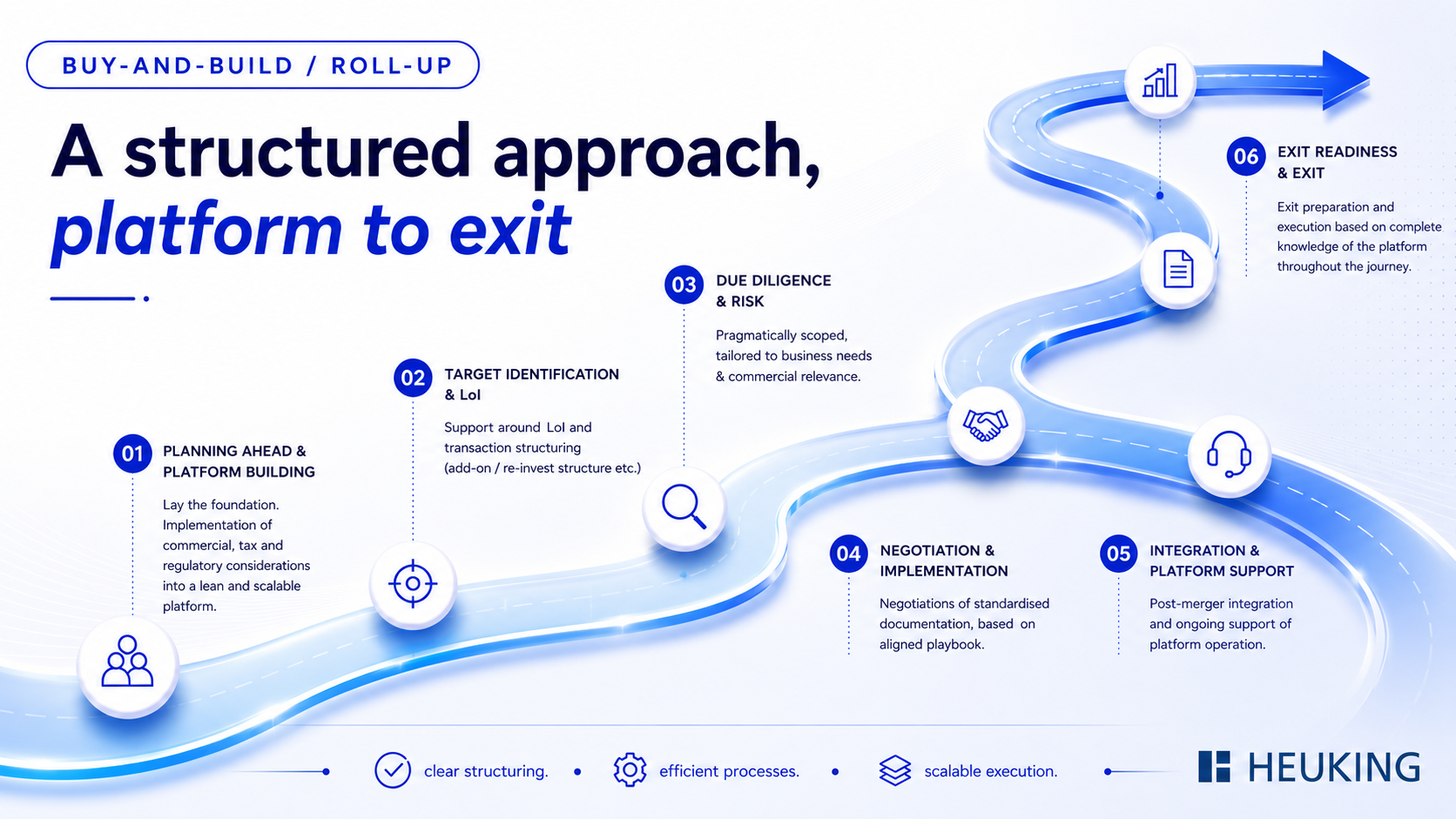
This part goes deeper on the platform itself as the starting point of the strategy. While individual add-on transactions tend to attract most of the public attention, execution requires putting first things first: one of the most significant success factors is a clean, purposeful design of the platform. It is not merely an acquisition vehicle – it is the legal, economic, and organisational pivot around which everything else turns.
Practice shows this clearly: the more carefully and forward-looking the platform is designed, the greater the scalability of the strategy, the lower the friction in subsequent add-ons, and the more resilient the model is to regulatory, financing, and other challenges down the line.
1. A deliberate starting point, not a by-product of the first transaction
A purposeful platform design depends materially on the specific economic and operational strategy, as well as any applicable regulatory requirements. These factors must drive the design and can in some cases call for highly individual configurations.
From a legal perspective, however, every such structure should be designed – in the interest of scalability – to meet at least the following criteria:
it should
accommodate add-ons, including potentially different types, without creating structural breaks;
anticipate financing requirements and individual deal conditions efficiently and adequately;
provide for rollover equity and incentivisation mechanisms;
consolidate governance processes efficiently; and
enable a clean, tax-efficient exit.
2. Base model as a key strategic decision
One of the most consequential early decisions is selecting the base model that fits the particular strategy. In our experience, different platform structures have established themselves in practice depending on the industry, the intended degree of integration, and the investor model.
a. Holding-centric models with a high degree of autonomy
In roll-ups targeting fragmented markets, a pure holding structure is often the preferred approach, under which the add-ons – typically numerous – remain legally independent entities. These models generally place significant emphasis on retaining all or selected sellers and managers, with operational intervention reserved for selective purposes: shared services functions, or group-wide standards on chosen matters.
This model frequently enables high acquisition velocity, seller willingness to share risk through deferred or contingent consideration, and lower operational integration hurdles. The challenges, beyond managing the tension between autonomy and group interest, can include limited levers for direct intervention and an elevated need for coordination at governance level.
b. Integrated platform models
At the other end of the spectrum sit integrated models, in which autonomous operation by add-on companies is deliberately limited and structural consolidation – through mergers, for instance – typically follows quickly. These models are usually built around a core operating platform company, the nucleus, to which add-ons are attached.
The challenges here include greater integration complexity and, at times, stronger reservations from employees, management, and sellers of the target companies. The advantages lie in a leaner group structure with a stronger unified identity, faster realisation of operational synergies, and clear leadership and decision-making hierarchies.
c. Hybrid models
In practice, investors most often opt for hybrid models tailored to the specific target industry and its particular complexities: add-ons that initially remain legally independent, combined with the stepwise operational integration of selected functions – procurement, IT, legal, HR – potentially followed by structural consolidation over time.
3. Governance
As the number of add-ons grows, the need for clear governance structures increases proportionally. At a conceptual level, governance must follow from the chosen base model and then requires further elaboration: where decisions are made and who makes them.
Typical governance elements include:
a clear allocation of authority between the investor, the holding or platform management, and the add-on managing directors;
defined approval processes and reserved matters – for acquisitions, investments, management changes;
and uniform reporting systems and KPIs.
In practice, these are implemented primarily through constitutional documents (such as articles of association), rules of procedure for the managing directors – ideally standardised across the group – and, where appropriate, shareholder agreements. Here too, the same principle applies: what works smoothly with three add-ons can quickly become dysfunctional and obstructive at ten or more. Part 3 of this series will therefore focus specifically on standardised template documentation – including the governance documentation that, depending on the base model, significantly touches on seller interests – designed to enable the efficient negotiation and execution of individual add-ons.
4. Group infrastructure
Particularly in light of operational and tax requirements, corporate groups generally require a suite of intra-group agreements. These should be tailored to the specific needs of the group and typically include a master services agreement, a group-wide data protection agreement, a cash pooling arrangement, and – where applicable – profit and loss transfer agreements.
5. Rollover equity, management equity programmes and role design
A central element of many strategies is the rollover equity participation of sellers and managers in the platform. This serves not only to partially finance the purchase price but, more importantly, to provide long-term incentivisation and commitment – for all or selected sellers and managers – to the platform group. The dynamic shifts decisively when sellers are aligned from day one with maximising the group's success and, by extension, its exit value.
For rollover equity to deliver its intended effect without creating unnecessary complexity, it should:
enable a tax-efficient entry – often via a rollover mechanism – and exit;
be structurally embedded cleanly in the platform and scalable;
be substantially limited to economic participation, with governance rights clearly demarcated; and
be drafted and communicated in a way that is straightforward to understand.
The focus on efficient handling matters here too. While rollover equity documentation must address many interrelated aspects carefully, overly lengthy and complex documentation has in our experience a tendency to slow negotiations considerably and, at times, to create difficulties beyond the negotiation table itself.
6. What follows in this series
With a sound platform structure in place, the essential prerequisites for efficient scaling are established.
There are equally important legal success factors in the execution of the individual add-on transactions themselves – and that is where the final part of this series turns. Part 3 addresses add-on transactions in the buy-and-build and roll-up context: efficient scaling through standardisation and sound judgement, covering due diligence scoping, learnings on transaction documentation, managing deal-by-deal particularities, and more.