Buy-and-Build / Roll-ups
Insights and Key Success Factors from a Legal Practitioner’s Perspective
In 2025, few topics have dominated the German transaction market, and the private equity landscape in particular, as consistently as buy-and-build and roll-up strategies. These are not new models. Both have been established and successfully executed in a wide range of industries and deal sizes, in Germany and internationally, for many years. Market observers see substantial further potential in the years ahead, not least driven by what has become known as the "VC roll-up craze".
This provides ample reason to take a structured look from a legal practitioner’s perspective. In this segment more than most, recurring patterns, clear success factors, and standardisable solutions can be identified – provided the buy-and-build or roll-up strategy is conceived not as a transaction-driven exercise "on the fly", but with sufficient lead time, clear objectives, and the involvement of specialist advisers from the outset, then executed with discipline.
This three-part series therefore examines the recurring structures, key decisions, and practical solutions from a legal perspective, offering a compact overview of the critical success factors across the full lifecycle of a buy-and-build strategy.
1. What Buy-and-Build and Roll-Ups actually are – definition and mechanics
The terms buy-and-build and roll-up are frequently used interchangeably, particularly in the Anglo-American market. Both describe the systematic construction of a corporate group or platform through a series of coordinated acquisitions – add-ons or bolt-ons. The defining feature is this: even the first transaction is not conceived as a standalone deal, but as the starting point of a repeatable, scalable model designed from day one for continuation and serial acquisitions.
Where the market does draw a distinction, it tends to run as follows:
Roll-ups in the narrower sense typically involve acquiring a large number of broadly comparable market participants in rapid succession – usually in regionally or functionally fragmented markets – with the platform often emerging as a pure holding structure.
Buy-and-build in the narrower sense, by contrast, describes models where a defining core business is first acquired as the platform nucleus, with further add-ons then attached to it deliberately over time.
What both approaches share is that they are – in keeping with the classic PE model – typically exit-oriented, with holding periods of around three to seven years. Alongside these, longer-horizon models also exist: evergreen structures and cashflow compounders that nonetheless regularly provide exit options for individual investors, shareholders, or management.
One structural question that must always be answered for the specific model at hand is how tightly the operational and organisational integration of the group companies is to be designed. Some models pursue rapid and comprehensive integration; others deliberately preserve greater entrepreneurial autonomy for the acquired businesses. This foundational decision has direct consequences for structure, governance, contract design, and post-merger integration.
The economic logic of buy-and-build and roll-up strategies – touched on here only briefly – rests on several elements:
accelerated inorganic growth;
operational synergies and efficiency gains across products, processes, procurement, IT, HR, and legal functions;
targeted market consolidation and market share gains; and
valuation effects at group level – what the market calls multiple arbitrage.
The goal is to generate value creation that materially exceeds the mere sum of individual targets. For sellers, this also means the ability to achieve significantly higher purchase prices – typically expressed as EBITDA multiples – than a conventional trade sale within their own industry would yield.
The typical target sectors are those with fragmented markets characterised by small and mid-sized participants, often regional in footprint and not optimally scaled operationally. Examples range from IT and software services to healthcare-adjacent businesses, trades and craft services, and regulated professional service structures.
In 2025, the roll-up strategy has also made a significant mark on the venture capital and start-up world. A number of investors – General Catalyst and 8VC among them – have been acquiring mature, labour-intensive services businesses at scale, spanning customer services, legal services, accounting, and IT services, as well as start-ups, with the primary aim of fundamentally transforming service delivery through the platform-wide deployment of artificial intelligence. The goal is an AI-native platform that achieves margin structures that remain out of reach for conventional software vendors. In doing so, these strategies borrow heavily from the private equity playbook, and in these segments the boundaries between venture capital and private equity are increasingly blurring.
2. Success factors from a legal perspective
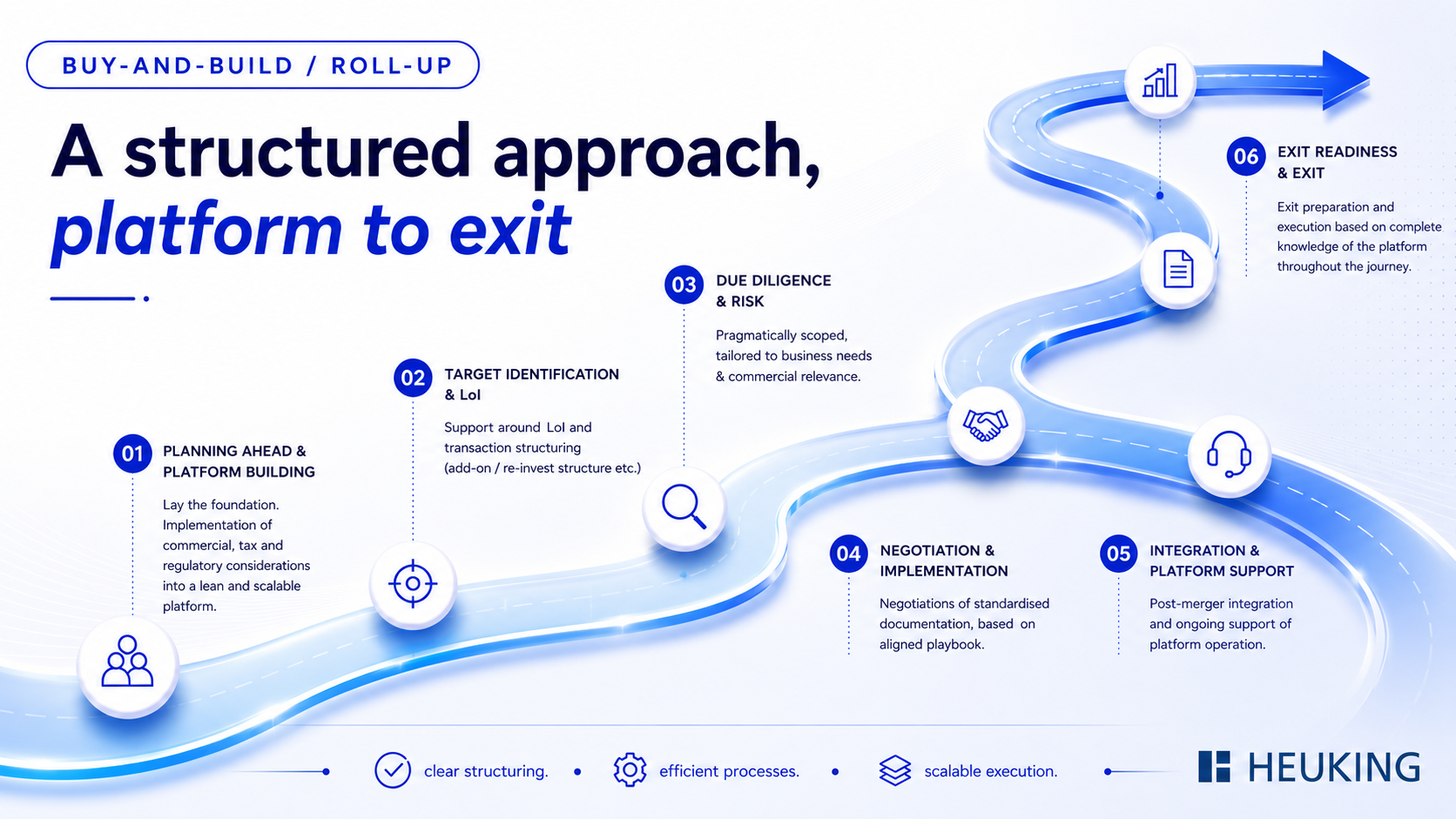
The emphasis on repetition and scalability is precisely what sets buy-and-build and roll-up strategies fundamentally apart from individual one-off transactions. The real challenge lies not in the first acquisition, but in building a model that is legally, organisationally, and operationally robust over the long term. A number of central success factors have emerged – each of which will be explored in greater depth in the subsequent parts of this series.
A clear platform structure that is sound from a regulatory, tax, and operational perspective – before the first add-on
Before the first bolt-on is executed, the structure on which the entire group will be built long-term should already be settled. This includes in particular the holding structure, the long-term financing logic, and the integration into the governance mechanisms of the financial investor. Equally important is how the structure connects with further elements: potential future seller rollover equity, possible co-investments by strategic partners such as industry experts, and incentive programmes for the operational team and, where relevant, key employees of add-on targets.
In regulated business areas, the central preliminary question is how to create a structure that is legally permissible on the longest possible horizon – ideally one already designed with headroom to adapt if the regulatory environment tightens.
Scalable acquisition documentation – including any rollover equity, earn-out, or bonus components – in place before the first add-on
Repetition is the core of these strategies. Accordingly, key transaction documents should be conceived early, modularly, and with a sense of proportion. It is therefore virtually essential – departing from the default logic of individual transactions – that the buyer rather than the seller provides the documentation, and that the buyer picks the notary, ideally one already familiar with the structure.
This encompasses:
standardised term sheets, SPA/APA frameworks, and foundation documents – articles of association, shareholder agreements, service contracts – built with a modular structure and optional schedules;
clear mechanics around liability and purchase price; and
a robust, clearly communicable, and practically implementable framework for rollover equity, earn-outs, and management incentivisation.
The focus should be on creating a documentation package that is easy to understand for sellers – who are often first-time participants in such processes – adapted to the specific industry and its particular challenges, and stripped back to the essentials. The goal is not maximum rigidity, but a solid framework that forms the foundation for efficient add-ons. It is particularly important to involve the acquirer – typically the financial investor – substantively in designing the template documentation, for instance through workshops, so that sector-specific and target-group-specific factors are built in from the start.
Consistent, standardised execution of add-ons with efficient timelines and clear process discipline
Building on that documentation, the transaction strategy should then be executed as consistently as possible. This is supported by a pragmatically scoped due diligence focused on core concerns, together with clear roadmaps, timelines, and defined responsibilities.
The advantages of a well-prepared, repetition-oriented approach should be exploited systematically. This includes making the bulk of the pre-drafted documentation available to sellers at an early stage. It is also typically understandable – and accepted – by sellers that a business model designed for numerous parallel and efficient transactions cannot accommodate the renegotiation of every individual point or the creation of unnecessary complexity. Certain structures and processes are simply non-negotiable – an effect that grows stronger with each successive transaction and an expanding track record. The trade-off, as a rule, is a purchase price multiple meaningfully above what a trade sale in the same industry would deliver.
That said, deviations from the standard will arise in virtually every deal and will sometimes be warranted. The decision to deviate should always be made consciously, as a deliberate exception – not out of a lack of process discipline or negotiating inertia. Over time, it often becomes possible to define a "standardised" range of flexibility for certain points and hand that to the deal team and advisers to work with autonomously.
Fine-tuning after the first transactions
Few deal settings offer the same opportunity as these strategies to draw concrete conclusions and apply them to future add-ons. Ongoing attention should be paid to refining the due diligence scope, the individual transaction documents, and the communication and negotiation processes – continuously raising efficiency. It is particularly worthwhile to compile with advisers a running list of typical negotiation points and the corresponding parameters and solutions, enabling them to act autonomously and efficiently. Realistically, a first round of this kind of fine-tuning can take place after the third add-on – but it should then be repeated at planned intervals thereafter.
3. What follows in this series
Buy-and-build and roll-up strategies offer substantial opportunity and are successfully executed in practice across a wide range of contexts. What ultimately matters, however, is approaching execution in a structured and disciplined manner – with clear guardrails, scalable frameworks, and a realistic view of the people and organisations involved.
The remaining parts of this series explore these themes in depth.
Part 2 addresses the platform as foundation – covering possible base structures, central governance decisions, and their implications for scalability and control.
Part 3 examines the efficient execution of add-on transactions – including due diligence scoping, learnings on transaction documentation, managing deal-by-deal particularities, and the dynamics of negotiation.